Peopleline℠ · Performance Support · HR & People Operations

HR owns the process.
Built for the moment
it arrives.

HR professionals receive the escalations supervisors cannot manage alone — harassment investigations, accommodation overlaps, termination reviews, EEOC charges. Peopleline℠ surfaces the complete response in the moment it is needed.

View situations →
14.7
discrimination, harassment, and retaliation issues per 1,000 employees in 2024 — the highest level ever recorded. One-third of organizations have no structured investigation process.
HR Acuity Benchmark, 2025
88,531
new EEOC discrimination charges filed in FY2024 — a 9.2% increase. EEOC secured $660 million for workers in FY2025.
EEOC, 2024–2025
96.5%
favorable result for EEOC in district court resolutions in FY2025. HR's response in the first 24 hours shapes every outcome that follows.
EEOC, 2025
Nova Routing Architecture · Session 136 · HR Position in the Room

Peopleline℠ receives what Supervisorline℠ cannot resolve alone.

Upstream: Supervisor Tier 2

Escalations from Supervisors

Protected class allegation — even informal. Leave or accommodation disclosure. Termination with a protected condition in the background. Any situation the supervisor could not manage within their authority.

HR Owns the Process

HR Investigates, Decides, Coordinates

HR conducts all formal investigations. HR manages the ADA/FMLA/PWFA interactive process. HR reviews terminations involving protected class members. HR coordinates with Legal on Tier 3 triggers.

Downstream: Tier 3 External

When HR Routes to Legal

EEOC charge received. DOL WHD complaint filed. NLRB charge. Employee has retained counsel. Any situation where HR's internal process is no longer sufficient and Legal must lead.

⚠ Hard rule: All formal investigations, termination decisions involving protected class members, and responses to EEOC/DOL charges require review by qualified legal counsel. HR manages the process — Legal owns the response to external charges.
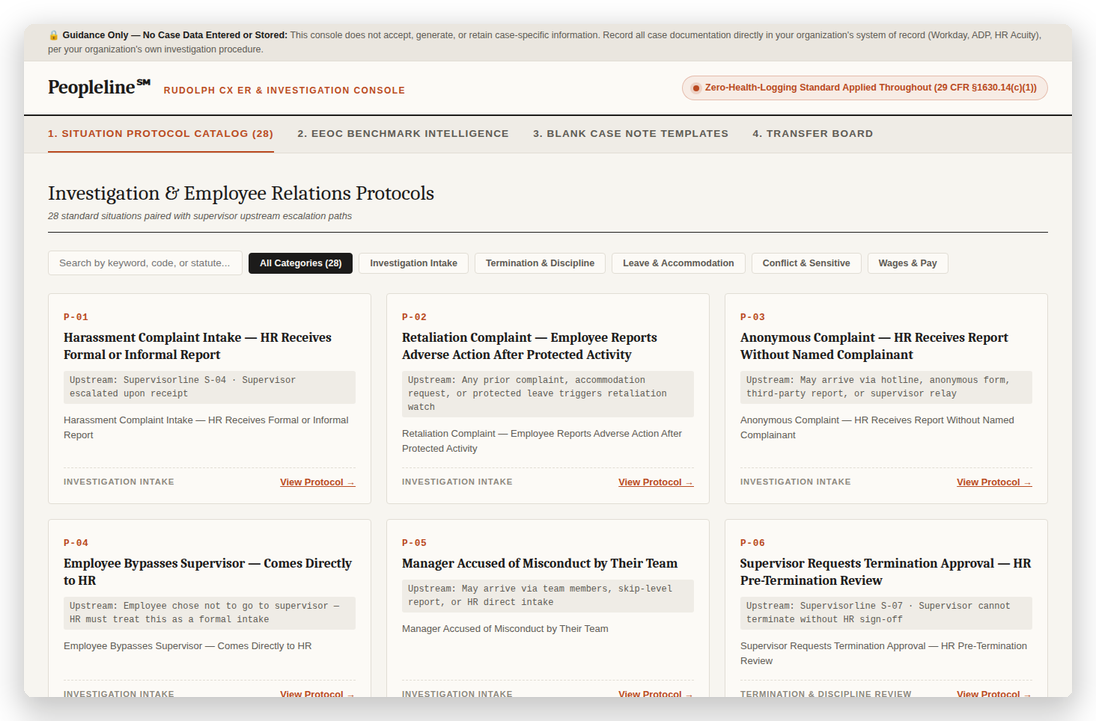
Situations

24 Situations — All 5 Categories

Investigation Intake
Upstream: Supervisorline S-04 · Supervisor escalated upon receipt
47.8%of all EEOC charges are retaliation claims. Most retaliation claims originate in how the organization responded to the initial complaint.EEOC / OnPay, 2026
  1. 1.Conduct an intake conversation with the complainant within 24–48 hours. The complainant's willingness to cooperate depends significantly on how quickly and seriously HR responds. Do not delay.
  2. 2.Document the intake verbatim where possible. Capture: what the complainant alleges, when, how often, who was present, whether witnesses exist, whether the complainant told anyone else, and what outcome they seek. Use the complainant's language — do not paraphrase.
  3. 3.Assess interim measures before investigation begins. Do parties need to be separated? Does the complainant need a schedule change or different reporting structure during the investigation? Interim measures are not punitive — they preserve investigation integrity and protect the complainant.
  4. 4.Brief Legal before interviewing the accused. If this complaint may escalate to an EEOC charge or litigation, the investigation may need to be conducted under attorney-client privilege. Determine that before the first interview.
  5. 5.Tell the complainant: the investigation will be thorough, as confidential as possible (not completely confidential), and conducted without retaliation. Do not promise a specific outcome or timeline beyond what you can deliver.
⚠ Anti-Retaliation Obligation Begins at Intake
From the moment a complaint is received, any adverse action against the complainant is potentially retaliatory regardless of whether a formal investigation is open. Document every action taken regarding the complainant during and after the investigation.
Title VII · ADEA · ADA · PWFA · EEOC Harassment Guidance (2024) · Anti-retaliation provisions all statutes
Upstream: Any prior complaint, accommodation request, or protected leave triggers retaliation watch
  1. 1.Establish the timeline immediately. What protected activity occurred? What adverse action followed? How close in time are they? Proximity alone does not prove retaliation, but it is the foundation of every retaliation claim.
  2. 2.Identify whether the adverse action was already in progress before the protected activity. A discipline process that was documented and underway before the complaint is a much stronger defense than one that appears to have started after. Pull the paper trail before any other step.
  3. 3.Identify who made the adverse decision and whether they knew about the protected activity. A supervisor unaware of the complaint when they made the decision has a stronger defense. A supervisor told about the complaint who then made the decision has significant exposure.
  4. 4.Brief Legal before taking any further action regarding the employee — whether continuing the discipline process, modifying it, or putting it on hold. Every action HR takes after a retaliation complaint becomes evidence.
  5. 5.Document the retaliation complaint in full. Open a separate investigation file — do not fold the retaliation complaint into the original complaint file. They are two separate matters with separate evidentiary records.
⚠ Retaliation Is the Most Common EEOC Charge
47.8% of all EEOC charges include retaliation. It is easier to prove than discrimination because it does not require proving discriminatory intent — only that protected activity occurred and adverse action followed. HR's documentation of the timeline and decision-making is the primary defense.
Title VII § 704(a) · ADA § 503 · FMLA anti-retaliation · NLRA Section 8(a)(4) · EEOC enforcement 2025
Upstream: May arrive via hotline, anonymous form, third-party report, or supervisor relay
  1. 1.Treat every anonymous complaint seriously. The absence of a named complainant does not reduce the obligation to investigate — it changes how you investigate. You cannot go back to the complainant for follow-up, so the initial documentation must be thorough.
  2. 2.Assess the specificity of the allegation. A specific allegation with dates, locations, names, and described behaviors can support an investigation even without a named complainant. A vague allegation requires more context before a formal investigation can proceed.
  3. 3.Consider whether the pattern of allegations points to a specific group of employees who may be experiencing the issue. HR has an independent obligation to address a documented pattern — not just document and file.
  4. 4.Do not attempt to identify the anonymous complainant. Efforts to identify and expose an anonymous reporter create retaliation exposure even if no adverse action is taken — the attempt itself can be retaliatory.
  5. 5.Document what was alleged, when HR received it, how HR assessed it, what investigation steps were taken, and the outcome. If no formal investigation was opened: document why and what threshold would trigger one.
⚠ The HRBP Conflict Dilemma
If the HRBP assigned to the business unit is close to the accused, assign an independent HR investigator or external investigator. An investigation led by an HRBP with a conflict of interest is a due process challenge.
Title VII · EEOC Guidance on workplace investigations · HR Acuity Benchmark 2025 · One-third of orgs have no structured process
Upstream: Employee chose not to go to supervisor — HR must treat this as a formal intake
  1. 1.When an employee comes directly to HR: receive the report fully. Do not redirect them back to their supervisor — especially if the complaint involves the supervisor. HR owns the process from this moment.
  2. 2.Ask why the employee chose not to go to the supervisor. The answer often reveals information about the nature of the complaint, prior attempts to resolve, or the supervisor's involvement. Document the response exactly.
  3. 3.Determine whether to notify the supervisor of the complaint. If the complaint involves the supervisor: do not notify until Legal has been briefed and interim measures are in place.
  4. 4.Assess whether the employee has faced any prior adverse action or retaliation risk. Ask directly: "Has anything changed for you at work since [the issue began]?"
  5. 5.Document the full intake and assign ownership. HR owns this investigation. Communicate that clearly to both the employee and the supervisor (without disclosing confidential details).
HR Position in the Room
When an employee goes directly to HR, they are exercising the organization's commitment to open channels. How HR receives that report determines whether other employees believe those channels are real.
Title VII · EEOC Guidance · Anti-retaliation provisions · HR Acuity Benchmark 2025
Upstream: May arrive via team members, skip-level report, or HR direct intake
  1. 1.Brief the manager's direct leader and Legal before any investigation step. This situation requires leadership awareness — it affects team operations and has organizational visibility.
  2. 2.Separate the accused manager from the investigation process entirely. They should not be informed of specifics, should not access complainants' personnel files, and should not make decisions affecting complainants during the investigation.
  3. 3.Interview team members individually. Multiple complainants does not mean a coordinated campaign — it may mean a pattern each employee individually experienced. Document each account separately before identifying patterns.
  4. 4.Assess whether the manager should be placed on administrative leave during the investigation. This is not punitive and does not imply guilt — it protects investigation integrity and reduces retaliation risk. Brief Legal before implementation.
  5. 5.Communicate to the team — without disclosing investigation details — that HR is engaged and the matter is being taken seriously. Silence during a high-visibility investigation damages trust regardless of the outcome.
⚠ If the Accused Manager Is a Senior Leader
An investigation of a VP, Director, or C-suite leader requires Legal from the first moment and often requires an external investigator. Internal HR investigations of senior leaders are subject to significant conflict-of-interest challenges.
Title VII · EEOC Guidance · HR Acuity Benchmark 2025 · External investigation for senior leaders
Termination & Discipline Review
Upstream: Supervisorline S-07 · Supervisor cannot terminate without HR sign-off
  1. 1.Pre-termination checklist: (a) documentation supported? (b) consistent with similar cases for other employees? (c) open EEOC/NLRB charge or active complaint? (d) employee on or recently returned from protected leave? (e) pending accommodation request? Any "yes" requires Legal review before proceeding.
  2. 2.Review comparator treatment. Pull records for other employees who committed the same or similar violations. If similarly situated employees of a different protected class were treated more leniently, the termination will not survive a disparate treatment challenge.
  3. 3.Confirm the documentation trail is complete: prior coaching, written warnings, PIP if applicable, employee's response at each stage, and the triggering final event.
  4. 4.Determine whether a separation agreement is appropriate. Brief Legal on terms before any promise of severance is made to the supervisor.
  5. 5.Coordinate logistics: final pay per state law, COBRA notice timing, property return, system access revocation. These are legal obligations with specific deadlines — not administrative afterthoughts.
⚠ Termination With Open Accommodation or Leave
Terminating an employee while an ADA accommodation request is pending, or while on FMLA leave, or within a close window after return from protected leave creates presumptive retaliation. Legal must review before any such termination proceeds.
Title VII · ADA · FMLA · ADEA · State final pay laws vary · WARN Act (for RIFs affecting 50+ employees)
Upstream: P-06 gate — any open accommodation or leave triggers this situation
  1. 1.Stop. Brief Legal before any action. A termination that occurs while an employee is on FMLA leave, ADA accommodation, or PWFA accommodation — or within a short window after return — is one of the highest-exposure decisions an organization can make.
  2. 2.Assess whether the termination rationale existed and was documented before the protected activity. Documentation that predates the protected activity is the primary defense. Documentation created or accelerated after the protected activity is a red flag.
  3. 3.Determine whether post-FMLA ADA additional leave analysis has been completed. When FMLA exhausts, the ADA may require additional unpaid leave as a reasonable accommodation. Legal must advise.
  4. 4.If the employee is on FMLA and termination is for a legitimate unrelated reason (position elimination): confirm the reason is applied consistently and would have occurred regardless of the leave. Document that determination before the termination.
  5. 5.Legal owns the termination decision in this situation. HR coordinates — Legal leads.
⚠ Highest-Exposure Termination Category
FMLA interference and ADA retaliation claims arising from termination while on leave are among the most common and most expensive employment law outcomes. The employee does not need to prove discriminatory intent — only that leave or accommodation was connected to the adverse action.
FMLA 29 CFR § 825.216 · ADA post-FMLA leave analysis · PWFA · EEOC Guidance on termination during leave
Upstream: P-06 pre-termination review or employee complaint about PIP
  1. 1.Pretext indicators: PIP initiated shortly after protected activity. PIP standards that are impossible to meet. PIP without prior coaching. PIP applied to this employee but not to similarly situated employees with the same issue. Any one is worth stopping to examine.
  2. 2.Pull comparator data before proceeding. Who else has had the same documented performance issues? What was the disciplinary response? Were standards applied consistently? Document this analysis in writing.
  3. 3.If pretext is identified: brief Legal immediately. Do not continue the PIP process while a potential pretext issue is under review.
  4. 4.Consider the supervisor's history with this employee and with protected class members generally. A pattern of more severe discipline for one protected class is a disparate treatment problem HR must address independently.
  5. 5.Document the HR review, the pretext concern, and the action taken. If the PIP is modified, withdrawn, or held: document why. If it proceeds after Legal review: document that Legal cleared it.
⚠ Disparate Discipline Equals Disparate Treatment
More severe outcomes for members of a protected class in similar factual situations is treated the same as disparate pay under Title VII analysis. HR's job is to catch and correct these patterns before they become EEOC charges.
Title VII disparate treatment analysis · McDonnell Douglas framework · ADEA · ADA · Pretext doctrine
Upstream: Supervisor requests termination during probationary period
  1. 1.Probationary status does not eliminate employment law protections. An employee terminated during their probationary period is still protected by Title VII, ADA, ADEA, FMLA, NLRA, and all applicable statutes from the moment of hire.
  2. 2.Apply the same pre-termination review as any other termination: protected class, open accommodations, recent complaints, and consistency with other probationary terminations for similar reasons.
  3. 3.If the employee is in a protected class and the termination rationale is vague ("not a good fit," "attitude issues"): require specificity before approving. Vague rationales are the hallmarks of pretext claims. The supervisor must identify observable, documented behaviors.
  4. 4.Confirm whether the employee has raised any complaints, requested accommodations, or taken protected leave during the probationary period. If yes: brief Legal before proceeding.
  5. 5.Process the termination per the same logistics as any termination: final pay per state law, COBRA notice, property return. Documentation requirements are identical to non-probationary terminations.
⚠ Probationary Period Does Not Mean Reduced Risk
EEOC charges from employees terminated in their first 90 days are not uncommon. "They were on probation" is not a defense to discrimination.
Title VII · ADA · ADEA · FMLA (triggers at 12 months — may not apply) · State law varies
Upstream: HR review of discipline records or supervisor escalation request reveals pattern
  1. 1.When HR identifies a supervisor applying different disciplinary standards to different employees — more lenient with one group, more severe with another — this is a disparate treatment pattern HR must address before it becomes an EEOC charge.
  2. 2.Pull all discipline records for the supervisor's team over the review period. Map violations, disciplinary responses, and employee protected class characteristics. Look for patterns: are terminations clustering in one group? Are verbal warnings clustering in another?
  3. 3.Brief Legal on the findings before any action is taken regarding the supervisor. A supervisor whose discipline pattern creates Title VII exposure is a management problem that HR addresses through the supervisor's leadership chain.
  4. 4.Determine whether any current pending discipline should be held while the pattern is reviewed. A termination pending while HR has identified an inconsistency pattern has heightened exposure.
  5. 5.Document the pattern analysis, findings, and corrective action plan. If the supervisor requires training, coaching, or discipline: that is separate from and does not reduce exposure from the underlying pattern.
⚠ Systemic Disparate Impact
If the pattern appears across multiple supervisors or departments, it may indicate a systemic disparate impact issue. Systemic cases attract EEOC pattern-or-practice scrutiny. Brief Legal immediately if the pattern is organization-wide.
Title VII disparate treatment and disparate impact · ADEA · ADA · McDonnell Douglas framework · EEOC pattern-or-practice guidance
Leave & Accommodation Escalation
Upstream: Supervisorline S-03, S-12 · Employee leave or accommodation involves multiple statutes
  1. 1.Identify which statutes apply and run them concurrently. FMLA provides up to 12 weeks of unpaid, job-protected leave. The ADA may require additional leave as a reasonable accommodation beyond FMLA. PWFA requires accommodation for pregnancy-related limitations even below the ADA disability threshold. All three can apply simultaneously.
  2. 2.Brief Legal before any leave denial or limitation decision. The interaction between these three statutes — particularly ADA post-FMLA leave — is one of the most litigated areas in employment law.
  3. 3.Initiate the FMLA process within 5 business days of learning the leave may be FMLA-qualifying. Issue the required notices: eligibility notice, rights and responsibilities notice, and designation notice. Failure to provide them tolls the leave clock and creates independent FMLA liability.
  4. 4.Separately initiate the ADA interactive process if the underlying condition may also be a disability. The ADA interactive process is a good-faith dialogue about accommodations — not the same as FMLA certification.
  5. 5.Document every step: notices issued, interactive process discussions, accommodation offers made, employee responses, medical documentation received, and the basis for any decision.
⚠ Post-FMLA ADA Analysis Is Mandatory Before Termination
When FMLA exhausts, HR cannot simply authorize termination. The ADA requires a separate analysis of whether additional leave or any other accommodation would allow the employee to perform essential functions. Legal must advise. This analysis must be documented before any termination.
FMLA 29 CFR § 825 · ADA 29 CFR § 1630 · PWFA (effective June 2023) · EEOC ADA/FMLA guidance
Upstream: Supervisor denied or delayed accommodation without HR review
  1. 1.If a supervisor denied an accommodation request without routing to HR: treat this as a new intake and conduct the interactive process from the beginning. The supervisor's denial does not stand — only HR (with Legal guidance where needed) can deny an ADA or PWFA accommodation after completing the interactive process.
  2. 2.Contact the employee immediately. "I understand you have an accommodation request. I'd like to talk with you about it directly." Do not reference the supervisor's denial in a way that validates it.
  3. 3.Conduct the interactive process: understand the limitation, identify essential job functions, explore accommodations, consider feasibility, and document the dialogue. The process must be good-faith — not a search for reasons to deny.
  4. 4.Address the supervisor's conduct separately. A supervisor who denied without HR review needs coaching on the ADA interactive process obligation. If the denial was related to protected class: that is a potential discrimination issue to investigate independently.
  5. 5.If accommodation is denied: Legal must review the undue hardship analysis and confirm it is complete and documented before the denial is communicated to the employee.
⚠ Delay Is Itself an ADA Violation
Unreasonable delay in the interactive process — including delay caused by a supervisor routing the employee in circles — can itself constitute an ADA violation. HR must initiate immediately upon learning of a denied or delayed accommodation.
ADA 29 CFR § 1630.9 · PWFA · Interactive process requirement · EEOC ADA guidance on undue hardship
Upstream: Supervisorline S-01, S-02, S-06 — supervisor paused and escalated upon disclosure
  1. 1.When an employee discloses a disability during a performance conversation, HR must immediately separate the performance process from the accommodation process. These are two distinct tracks that must be managed independently.
  2. 2.Put the discipline process on hold while HR initiates the ADA interactive process. Do not allow the discipline process to continue or accelerate while an accommodation request is pending — that creates the appearance of retaliation for the disclosure.
  3. 3.Brief Legal immediately. Legal must advise on how to manage both tracks without contaminating either.
  4. 4.Conduct the interactive process. Explore whether accommodation would allow the employee to meet the performance standard. If yes: provide the accommodation and assess performance from there. If no: Legal advises on whether the discipline process may proceed.
  5. 5.Maintain ADA confidentiality. The disability disclosure and accommodation process are confidential. Performance documentation and accommodation documentation must be maintained in separate files.
⚠ The Disclosure Changes the Frame
Before the disclosure: a performance case. After the disclosure: a performance case that also requires an ADA interactive process before discipline can proceed. The order matters enormously for liability management.
ADA · PWFA · FMLA (if leave-qualifying) · ADA confidentiality 29 CFR § 1630.14 · EEOC enforcement 2025
Upstream: Employee has exhausted informal resolution and filed a formal written grievance
  1. 1.Acknowledge receipt of the grievance in writing within the timeframe specified by your grievance policy. A failure to acknowledge within the policy window is itself a procedural violation that undermines the organization's ability to defend the process.
  2. 2.Assess the grievance for protected class content, ADA/FMLA implications, and any claims that could constitute an EEOC-cognizable charge. If any such content is present: brief Legal before conducting the grievance investigation.
  3. 3.Assign an investigator who is independent of the parties and the subject matter. In union environments: review the CBA for grievance procedure requirements and timelines — these are contractual obligations with specific remedies for breach.
  4. 4.Conduct the investigation per policy: interview the grievant, gather documents, interview witnesses, and analyze the facts against the policy or contractual standard being invoked. Issue a written decision within the policy-specified timeframe.
  5. 5.The written decision must state: findings of fact, the policy or standard applied, and the outcome. If sustained: state the remedy. If denied: state the basis in terms that will hold up to external review.
⚠ A Formal Grievance Is External-Facing
How HR responds to a formal grievance is often exhibit A in subsequent EEOC proceedings or litigation. The written decision must be legally defensible. Brief Legal on the decision before it is issued in writing.
Organizational grievance policy · CBA if applicable · Title VII · NLRA Section 7 (protected activity)
Conflict & Sensitive
Upstream: P-05 or direct HR intake — accused is VP, Director, or C-suite
  1. 1.Brief the CHRO and Legal within hours of receiving the complaint — not days. A senior leader investigation cannot be managed at the HRBP level. The CHRO and Legal must own the decision-making from the first moment.
  2. 2.Engage an external investigator. Internal HR investigations of senior leaders are credibility challenges — real and perceived. An external investigator removes the conflict of interest and produces a report more defensible in litigation. Legal selects the investigator.
  3. 3.Determine whether the senior leader should be placed on administrative leave. This decision is made by the CHRO and Legal. If the leader remains in the workplace: establish guardrails to prevent intimidation of witnesses or interference with the investigation.
  4. 4.Manage board communication if the accused is a C-suite officer or if the complaint creates D&O liability exposure. In publicly traded companies, senior leader misconduct investigations may require board notification and disclosure analysis. Legal leads this assessment.
  5. 5.Communicate to the complainant that the matter is being taken seriously, that an independent investigator has been engaged, and that retaliation is prohibited. Give the complainant an HR contact who is not the investigation lead.
⚠ EEOC Secured $660M for Workers in FY2025
Senior leader misconduct investigations conducted internally or resulting in no consequence for the accused create both the fact and the appearance of impunity. EEOC enforcement targets organizations where leadership accountability structures fail.
Title VII · EEOC enforcement 2025 ($660M secured) · External investigation protocol · D&O considerations for C-suite
Upstream: Tier 3 trigger · Legal owns from this moment · HR coordinates document collection
  1. 1.Brief Legal the same day the charge is received. The EEOC requires a position statement response — typically within 30 days, sometimes with extension. Legal must lead the response strategy. HR collects and organizes documents — it does not draft the position statement independently.
  2. 2.Issue a litigation hold immediately. Preserve all documents related to the charging party's employment, the alleged conduct, any investigation, and any challenged decision-making. Failure to preserve after receiving a charge is spoliation.
  3. 3.Do not contact the charging party directly. Once a charge is filed, communication goes through Legal or, if the charging party has representation, through their counsel.
  4. 4.Do not retaliate against the charging party or any witnesses. Issue a communication to relevant supervisors that the matter is active and retaliation is prohibited. This communication becomes evidence of the organization's commitment to non-retaliation.
  5. 5.Coordinate document collection that Legal will need: complete personnel file, all discipline records, investigation records, emails related to the alleged conduct, comparator records, and relevant policies. Organize chronologically before delivering to Legal.
⚠ EEOC Favorable Result in 96.5% of District Court Resolutions
The EEOC's success rate means that cases that survive to litigation are not easily won. The position statement, document collection, and anti-retaliation measures taken immediately after charge receipt determine the organization's litigation posture.
Title VII · ADA · ADEA · EEOC charge response process · Litigation hold obligation · Spoliation doctrine
Upstream: Employee disclosure or supervisor escalation — DV situation creating workplace impact
  1. 1.Lead with safety. If the employee believes an abuser may come to the workplace: activate security protocols, notify building security, and document the threat assessment. Safety comes first.
  2. 2.Many states have domestic violence leave laws providing protected leave for survivors — for medical attention, legal proceedings, safety planning, or relocation. Know your state's current law. HR must not penalize attendance issues covered by state DV leave protections.
  3. 3.ADA may apply if the DV situation has created or exacerbated a covered disability (PTSD, depression, anxiety). If the employee requests an accommodation for a related mental health condition: initiate the ADA interactive process separately.
  4. 4.Maintain strict confidentiality. The employee's DV situation must not be shared beyond those with a direct need to know. Disclosure without consent can create safety risks and legal liability.
  5. 5.Provide EAP information and DV-specific resources if available. Do not require use. "We have EAP available — they work with DV situations and it's completely confidential from HR."
⚠ State DV Leave Laws Vary Significantly
CA, CO, IL, NJ, NY, WA and many other states have specific DV leave protections. Some apply to all employers; some have size thresholds. HR must verify the applicable law before any attendance action regarding an employee who has disclosed a DV situation.
State DV leave laws vary · ADA (if mental health condition) · FMLA (if serious health condition) · OSHA (workplace safety obligation)
Upstream: Leadership presents proposed RIF selection list for HR/Legal review
  1. 1.Before any RIF list is finalized: conduct a disparate impact analysis. Map selected employees by protected class characteristics. Compare to the composition of the pool from which selections were made. Any protected class appearing disproportionately in the RIF selections triggers further legal analysis.
  2. 2.ADEA considerations are acute in RIFs. If employees over 40 are disproportionately selected: brief Legal immediately. The OWBPA requires specific disclosures in separation agreements for employees over 40, including 45-day consideration period and 7-day revocation rights.
  3. 3.Confirm that selection criteria are objective, documented, and applied consistently. "Performance-based" RIFs must use documented, measurable criteria — not supervisory impressions.
  4. 4.Assess whether any selected employee has an open accommodation, active complaint, or pending EEOC charge. If yes: brief Legal before finalizing that individual's inclusion.
  5. 5.WARN Act: if the RIF involves 50 or more employees at a single site within a 30-day period, the WARN Act requires 60 days advance written notice to affected employees, state agencies, and local officials. Failure creates liability for 60 days of back pay and benefits.
⚠ ADEA + OWBPA Requirements Are Non-Waivable
Separation agreements for employees over 40 must meet specific OWBPA requirements. An agreement that doesn't meet OWBPA requirements is unenforceable as a release of ADEA claims — regardless of business pressure to finalize.
Title VII disparate impact (Griggs doctrine) · ADEA · OWBPA · WARN Act (29 U.S.C. § 2101) · ADA · State WARN laws may be broader
Wages & Pay
Upstream: Annual merit cycle or triggered by pay equity complaint
14.7issues per 1,000 employees in 2024 — an all-time high. Pay equity issues are the fastest-growing category in HR Acuity's benchmark.HR Acuity Benchmark, 2025
  1. 1.Before finalizing merit increases: run a disparate impact analysis on proposed increases by protected class. If one group is consistently receiving lower increases than comparable employees in other groups: pause for analysis before the cycle is communicated.
  2. 2.Identify the source of disparities. Are certain supervisors consistently recommending lower increases for members of a protected class? Is the performance rating distribution itself skewed? Are retention raises accruing disproportionately to one group?
  3. 3.Brief Legal if a statistically significant disparity is identified. The EPA imposes strict liability for pay disparities in equal work — intent does not matter. Title VII covers pay discrimination tied to protected class. Legal must assess before any communication to employees.
  4. 4.Do not communicate merit increases to employees until the analysis is complete and Legal has cleared the distribution. Correcting a discriminatory merit cycle after communication creates larger liability than catching it before.
  5. 5.Document the analysis, findings, and any adjustments made. A good-faith pay equity review — even one that identified and corrected problems — is a significantly stronger position than an absence of any review.
⚠ Pay Inequity Builds Through Unexamined Decisions
Pay disparities rarely originate in deliberate discrimination. They accumulate through small, unexamined decisions across raise, bonus, and retention cycles. The merit cycle review is the most efficient point to catch and correct them.
EPA (strict liability) · Title VII pay discrimination · ADEA · State equal pay laws · People415 / DLA Piper 2025
Upstream: Employee raises pay equity concern with supervisor (Supervisorline S-24) → escalated to HR
  1. 1.Brief Legal the same day. A pay equity complaint is a potential EPA and/or Title VII claim. Legal must assess the exposure before HR conducts any comparator analysis or communicates anything to the complaining employee about their pay relative to peers.
  2. 2.Pull comparator data — under Legal guidance. Which employees are similarly situated (same job duties, experience level, performance rating, location)? What are their pay rates? Legal will advise on what comparator analysis to conduct and how to protect it under privilege.
  3. 3.Issue a litigation hold on all pay-related records for the complainant and identified comparators. Do not wait for a formal EEOC charge — a pay equity complaint is sufficient to trigger preservation obligations.
  4. 4.Do not make any pay adjustments before Legal has reviewed the comparator analysis. An immediate adjustment without complete analysis can create new disparities and may constitute an admission in subsequent proceedings.
  5. 5.Anti-retaliation: document the complaint intake and communicate to the complainant's supervisor that retaliation is prohibited. Any adverse action after the complaint is filed will be scrutinized as potential retaliation.
⚠ EPA Imposes Strict Liability — Intent Is Not a Defense
Under the Equal Pay Act, if a pay disparity exists for equal work and no affirmative defense applies, the employer is liable regardless of intent. The legal analysis must be complete before any response is made.
EPA 29 U.S.C. § 206(d) · Title VII pay discrimination · Dunlap & Shipman 2025 (strict liability) · State equal pay laws · DLA Piper 2025
Upstream: Supervisorline S-16 — supervisor disciplined employee for discussing wages
  1. 1.Assess the nature of the violation: (a) NLRA Section 7 — supervisor disciplined an employee for discussing wages or issued a policy prohibiting wage discussion. (b) State pay transparency law — supervisor or organization failed to disclose pay ranges when required. Both require Legal review; both have different remediation paths.
  2. 2.If an employee was disciplined for discussing wages: the discipline must be rescinded immediately. Brief Legal on the rescission process and NLRB unfair labor practice exposure. The rescission must be communicated to the employee in writing.
  3. 3.If a policy prohibits wage discussion: the policy must be revised or rescinded. Brief Legal on how to communicate the change. An unlawful policy in effect for an extended period may require proactive communication to affected employees.
  4. 4.Address the supervisor's conduct through training and, if the violation was deliberate, through discipline. A supervisor who knowingly disciplined an employee for protected wage discussion has committed an unfair labor practice that HR cannot simply absorb as a training gap.
  5. 5.Review all relevant pay-related policies for NLRA compliance. This violation often reveals that the handbook contains a confidentiality clause that inadvertently restricts wage discussions — a separate remediation item for Legal.
⚠ NLRB Will Act on Unfair Labor Practice Charges
NLRB charges are free to file, and the NLRB actively pursues them. An employer who disciplines an employee for wage discussion, and does not promptly remediate, is creating an NLRB case file.
NLRA Section 7 · NLRA Section 8(a)(1) · State pay transparency laws (17 states + D.C. as of 2026) · NLRB enforcement
Upstream: Leadership requests retention raise for individual employee · HR must assess comparator impact
  1. 1.Before approving any off-cycle retention raise: assess the comparator impact. Who are the similarly situated employees in the same role, level, and location? Will the proposed retention raise create or expand a disparity by protected class?
  2. 2.If the retention raise will create a pay disparity between the recipient and similarly situated employees of a different protected class: brief Legal before approving. The EPA and Title VII pay provisions apply to the resulting disparity regardless of intent.
  3. 3.Consider whether comparable retention situations have been handled consistently. If retention raises have historically been offered more to one demographic group, the pattern itself is a pay equity problem.
  4. 4.Document the business reason for the retention raise: market data, flight risk assessment, skills or experience that justify the premium. The business reason is the foundation of the affirmative defense if the raise is challenged.
  5. 5.After the raise is implemented: monitor for subsequent complaints from comparators. A retention raise that creates a visible disparity often generates inquiries from peers within the next merit cycle.
⚠ Retention Raises Accrue Disproportionately in High-Risk Patterns
DLA Piper 2025 research confirms that retention raises, off-cycle adjustments, and market corrections frequently cluster in ways that create protected class disparities — not because of discriminatory intent, but because they occur outside the structured review process where equity checks happen.
EPA · Title VII · DLA Piper 2025 pay equity research · State equal pay laws · HR Acuity Benchmark 2025
Upstream: Supervisorline S-23 — supervisor provided pay range · Employee now alleges they should be higher in range
  1. 1.Determine the nature of the employee's concern. General dissatisfaction with range position? Or allegation that they are paid less because of a protected class characteristic? The first is a compensation conversation. The second is a pay equity complaint requiring Legal involvement.
  2. 2.If the concern is general: explain the factors that determine range position — performance, tenure, market data, internal equity. If the organization cannot articulate a non-discriminatory reason: brief Legal.
  3. 3.If the employee raises a protected class allegation — even informally: treat as a formal pay equity complaint. Brief Legal immediately and initiate the P-20 protocol.
  4. 4.Do not disclose other employees' specific pay rates. You can acknowledge that the organization reviews pay equity without disclosing specific comparator data.
  5. 5.Document the conversation and the outcome: concern raised, explanation provided, any escalation triggered, and follow-up committed to.
The Pay Transparency Moment
As pay transparency laws require more range disclosure, employees will increasingly compare their position in the range to their expectations and peers. HR must be prepared for this conversation at scale — with consistent, documented, non-discriminatory explanations for range positioning.
State pay transparency laws · EPA · Title VII · NLRA Section 7 (wage discussion rights) · PBW Law 2026
Upstream: P-06 approval complete · HR attends all involuntary separations as witness and process anchor
  1. 1.HR's role in the termination conversation is witness and process anchor — not co-communicator. The supervisor or manager delivers the decision. HR is present to ensure the process is followed correctly, answer benefits questions, and document what was said by all parties.
  2. 2.Before the conversation: confirm all logistics are ready — final paycheck per state law (same-day or next-business-day in most states), COBRA notice prepared, separation agreement if applicable, system access revocation scheduled, property return protocol confirmed.
  3. 3.During the conversation: take contemporaneous notes of what is said by all parties. If the employee makes a statement that could constitute a protected class allegation or a retaliation claim — document the exact words. These notes are the evidentiary record if the termination is subsequently challenged.
  4. 4.If the employee becomes significantly distressed or raises a new issue during the conversation (discloses a medical condition, makes a protected class allegation): HR may need to pause the conversation and consult Legal before proceeding. Document the pause and the reason.
  5. 5.After the conversation: complete the separation checklist — COBRA timing, final pay processing, reference policy communication, unemployment documentation, HRIS update. All steps within the legally required timeframes.
HR Is the Process — Not the Decision
HR's presence in the termination conversation is to ensure legal compliance, complete documentation, and protect the employee's rights — including final pay and COBRA. HR is not present to soften the message.
State final pay laws vary · COBRA (29 U.S.C. § 1161) · WARN Act where applicable · Title VII anti-retaliation · Organizational separation policy
This guide supports HR professionals in managing complex workplace situations. It does not constitute legal advice. All formal investigations, termination decisions involving protected class members, and responses to EEOC/DOL charges require review by qualified legal counsel. Regulatory citations reflect research as of Session 131 (June 2026). Verify currency before applying. Built from 3-track primary source research · Nova routing rules Session 136 · Rudolph CX LLC
Pricing

One process. One contract.
Built for your organization.

Peopleline℠ follows the same proven build process as every Rudolph CX guide. Custom-built from your organization's situations, HR policies, and regulatory landscape. Delivered in two weeks. No IT required.

Book a discovery call →
Start Here

Request a custom build
for your organization.

Tell us your role and industry. We'll send a sample built from a situation your HR team faces — before any commitment.

Book Discovery Call — $300 →
or email directly: jamal@rudolphcx.com