Reentry · Criminal Justice · Community Navigation

Built for the
moment the
client is back.

Reentryline is a custom-built reference guide for reentry specialists, parole officers, and community-based navigators who face live, high-stakes moments with people returning from incarceration — SSI reinstatement windows, Medicaid reactivation, housing eligibility, supervision violations — and need the right move right now.

Works offline — single HTML file, no internet required
Reentryline — Live Situation
“Client was released two weeks ago. They had SSI before incarceration. Now they’re asking if they have to start over with a whole new application.”
The guide surfaces the 12-month SSI reinstatement window, the bring-release-papers-to-SSA path, and the no-new-application rule. The specialist acts immediately — before the window closes.
✓ Handled — Reentryline found the right move
Reentryline — Live Situation
“Client needs housing. I told them they can’t get subsidized housing because of their record. Now they’re asking me to show them where that rule is.”
The guide surfaces that the HUD One-Strike rule was withdrawn in 2025. Many formerly incarcerated individuals are eligible. The navigator corrects the error before it costs the client housing.
✓ Handled — Reentryline found the right move
Reentryline — Live Situation
“Client disclosed something that might be a supervision violation. They’re asking me what to do. Do I tell them to report or not?”
The guide surfaces the hard stop: advising on whether to report a supervision violation is legal advice. The specialist refers to legal counsel immediately. The client’s trust is honored. No legal exposure created.
✓ Handled — Reentryline found the right move
The Problem

Reentry navigators are trained for the process.
Not for the moment inside it.

Reentry organizations invest in training, certification programs, and policy documentation. Navigators complete them, understand the benefit landscape, and go to the floor.

Then the live moments start. A client released three weeks ago asks if they need a new SSI application — and the 12-month window is closing. A navigator tells a client they can’t get housing because of their record — not knowing the HUD One-Strike rule was withdrawn. A client discloses a potential supervision violation and asks what to do.

This is not a training failure. Training prepared the navigator for the regulation. It didn’t prepare them for this specific client, this specific deadline, right now.

Reentryline is built for that gap. Not a policy binder. Not another system login. A guide that lives inside the moment — regulation-grounded, deadline-aware, and ready the day the navigator goes live.

“The period immediately after release is the highest-risk window. Missed benefit deadlines in the first 30 days post-release are associated with significantly elevated recidivism and mortality risk.”
Reentryline Guide — Primary Source Research, Session 99 · Rudolph CX LLC
  • 01
    Built from your organization’s policies and population
    Every situation in Reentryline is built from your organization’s actual source material, supervision context, and service protocols — not generic scripts.
  • 02
    Current law embedded from the start
    Medicaid Jan 1 2026 reinstatement rule, HUD One-Strike withdrawal, Second Chance Act reauthorization, 42 CFR Part 2 enforcement — built in, not bolted on.
  • 03
    Ready on the day the navigator goes live
    Delivered as a single HTML file. No login. No app. No friction. Open it when the client is in the room.
Regulatory Foundation
  • Second Chance Act — P.L. 110-199 (enacted 2008; last reauthorized 2018 via First Step Act)
  • Fair Chance Act — P.L. 116-92 (effective December 2021)
  • Medicaid Suspension Rule — Consolidated Appropriations Act 2024 (eff. Jan 1, 2026)
  • SSI Reinstatement — 42 U.S.C. § 1382(e)(1) · 12-month window
  • SNAP / PRWORA 1996 — drug felony rules vary by state
  • MHPAEA Final Rule — effective November 22, 2024
  • 42 CFR Part 2 — SUD records (enforcement February 16, 2026)
  • VAWA Housing — 24 CFR Part 5 Subpart L
What Reentryline Covers

The moments that define reentry navigation.

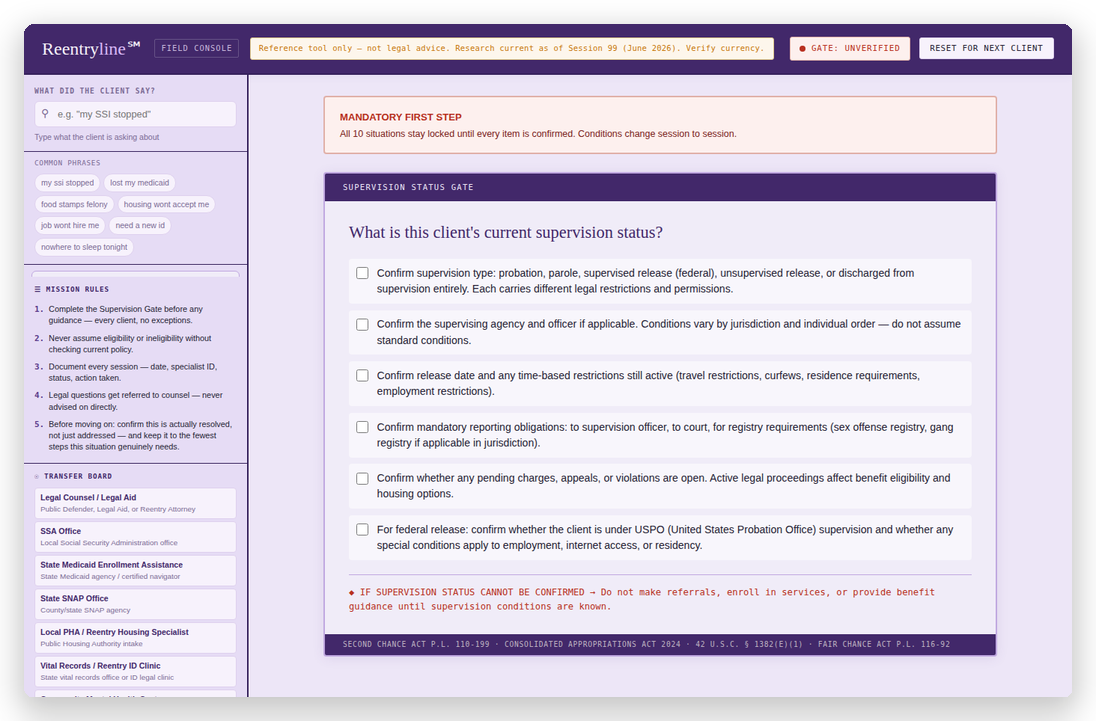
Supervision status is confirmed first, every session. Then the situation that matches. Each path is sourced from primary federal law — Second Chance Act, SSI, Medicaid, SNAP, MHPAEA, Fair Chance Act — and verified against current enforcement dates.

10 situations · Supervision gate first, every time · Your Reentryline is built from your source material
S-01
SSI Reinstatement
12-month reinstatement window from suspension date. Bring release papers to SSA — no new application if within window. Over 12 months: new application required. Act immediately if client is within window.
42 U.S.C. § 1382(e)(1) · SSA POMS SI 02301
▲ 12-month window — hard deadline from suspension date
S-02
Medicaid Reinstatement (Jan 1, 2026)
For incarceration after Jan 1, 2026: Medicaid was suspended, not terminated. Reinstatement process — no new application. Bring release papers to state Medicaid agency. Pre-Jan 2026: verify state rules.
Consolidated Appropriations Act 2024 · Eff. Jan 1, 2026
▲ 2026 change — reinstatement, not reapplication
S-03
SNAP Eligibility — Drug Felony
Drug felony SNAP ban is state-by-state under PRWORA 1996. Many states have fully lifted the ban. Never assume ineligibility without checking current state policy. Fugitive felon rule applies. Verify every time.
SNAP / PRWORA 1996 · USDA SNAP policy database
▲ State-by-state — verify before advising
S-04
Housing — Subsidized Eligibility
HUD One-Strike proposed rule was withdrawn in 2025. Many formerly incarcerated individuals can be eligible for subsidized housing. PHAs retain some discretion. Hard bars remain for certain sex offenses and meth manufacture. Navigate case by case.
HUD One-Strike — withdrawn 2025 · VAWA 24 CFR Part 5 Subpart L
S-05
Employment — Fair Chance Act
Federal contractors: criminal history question comes after conditional offer — not on application, not in interview. Second Chance Act programs remain active. Verify jurisdiction for broader state bans.
Fair Chance Act P.L. 116-92 · Second Chance Act P.L. 110-199
S-06
ID and Documents
Without a state-issued ID, almost nothing else in reentry can happen. ID is the anchor document — prioritize it above all else. Many states provide free state ID at release. SSA card and birth certificate paths confirmed before any other referral.
SSA · State vital records · Second Chance Act reentry programs
S-07
Mental Health and SUD Access
Medicaid is the primary payer for behavioral health for reentry populations. MHPAEA Final Rule (eff. Nov 22, 2024): mental health and SUD benefits at parity. 42 CFR Part 2 governs SUD records — standard HIPAA authorization is insufficient. Enforcement active Feb 16, 2026.
MHPAEA Final Rule (eff. Nov 22, 2024) · 42 CFR Part 2
▲ 42 CFR Part 2 enforcement Feb 16, 2026
S-08
Child Support — Arrears
In many states, child support accrues during incarceration. File for modification immediately upon release — courts will not retroactively reduce arrears before the filing date. Every day without a filing is a day of accruing debt. Do not give legal advice.
State family court rules vary · OCSE federal standards
▲ File for modification immediately — retroactive only to filing date
S-09
Supervision Violation Disclosure
Do not advise the client on whether to report or not report to their supervision officer. That is a legal decision. Refer immediately to legal counsel. Document that disclosure occurred, referral was made, and no legal advice was given.
Supervision conditions vary by jurisdiction · Rudolph CX Methodology
▲ Do not advise — refer to legal counsel
S-10
Client in Crisis — Housing or Financial Emergency
Stabilize first. A client in housing or financial crisis cannot effectively engage in reentry planning. Housing First applies — sobriety and compliance cannot be conditions of CoC-funded emergency shelter. Do not leave without a concrete next action.
HUD Housing First · WIOA Rapid Response · Second Chance Act
S-11
Employer Not Paying Wages — Wage Theft Complaint
DOL Referral
$259M recovered in back wages for 177,000 workers in FY2025 — averaging $1,465 per worker. U.S. Department of Labor, January 2026
  1. 1.Confirm the employment details: employer name and address, dates of employment, type of work performed, wages owed (hourly rate or salary), and pay periods affected. Document specifically.
  2. 2.Confirm whether the client received any wages at all, or whether wages were partially withheld. Both are FLSA violations if intentional and not corrected. The statute of limitations is 2 years for standard violations, 3 years for willful violations.
  3. 3.Confirm supervision conditions before proceeding. Engaging with DOL may require identity disclosure. If the client has supervision conditions affecting contact with government agencies, confirm with their supervision officer first.
  4. 4.Refer to DOL Wage and Hour Division: dol.gov/agencies/whd or call 1-866-4-USWAGE (1-866-487-9243). The complaint can be filed online, by phone, or in person at a local WHD office. No attorney is required to file. Complaints are confidential — WHD does not reveal the complainant's identity to the employer without consent.
  5. 5.Document: employer details recorded, DOL WHD referral made, complaint filing method confirmed, and any follow-up steps provided to client. Note that complaints can be filed even after employment has ended.
⚠ FLSA Personal Liability
Managers and supervisors can be held personally liable for FLSA violations — including when they did not know the violations occurred. If the client's employer is a small operation, the owner may be directly liable. This is not just a company-level issue.
✦ Tips Always Belong to the Worker
Under the FLSA, supervisors are prohibited from keeping any portion of tips earned by employees. If the client reports tip theft, this is a separate FLSA violation — include it in the DOL complaint.
FLSA 29 U.S.C. § 206-207 · DOL Wage and Hour Division · Back wages recoverable up to 3 years (willful) · Liquidated damages may double recovery
Pricing

One process. One contract.
Built for your organization.

Reentryline follows the same proven build process as every Rudolph CX guide. It starts with a discovery call.

Discovery Call
$300
Non-refundable. Credits in full to your first invoice if you proceed. The discovery call is where we understand your organization’s service population, supervision context, and the live moments your navigators face — so we can recommend the right build scope before you commit to anything.
Build Tiers
$2,500 — $8,000+
Four tiers based on role complexity, number of situations, and scope. Your discovery call determines the right tier. 50% deposit before work begins. 50% on delivery.
Book Discovery Call — $300
Annual Update Retainer
$750 / guide / year

Reentry benefit rules change through federal legislation, state policy, and regulatory enforcement. The annual retainer keeps your guide current. Covers one review cycle with revisions. Scoped changes outside the annual cycle are billed as change orders.

Build Standard

Built for everyone in the room.

Every Reentryline guide is built to serve all workers and all clients — regardless of background, circumstance, or identity. Biased towards is the pattern we catch, not only biased against. Single fathers, men in family court, reentry populations, people with non-apparent circumstances — this standard applies to every situation, every path, every word.

Ready to build a guide for
your navigators?

Tell us about your organization, your service population, and the moments your navigators face. We’ll take it from there.

We’ll respond within one business day to schedule your discovery call.
The $300 fee is collected at scheduling and credits to your first invoice if you proceed.

This guide is an operational reference tool for frontline workers. It does not constitute legal, medical, regulatory, or professional advice. Regulatory citations reflect research as of the guide’s last build date — verify currency before applying. Always consult qualified counsel for legal questions. Rudolph CX LLC · Durham, NC · rudolphcx.com