See It Work
The real console, not a mockup.
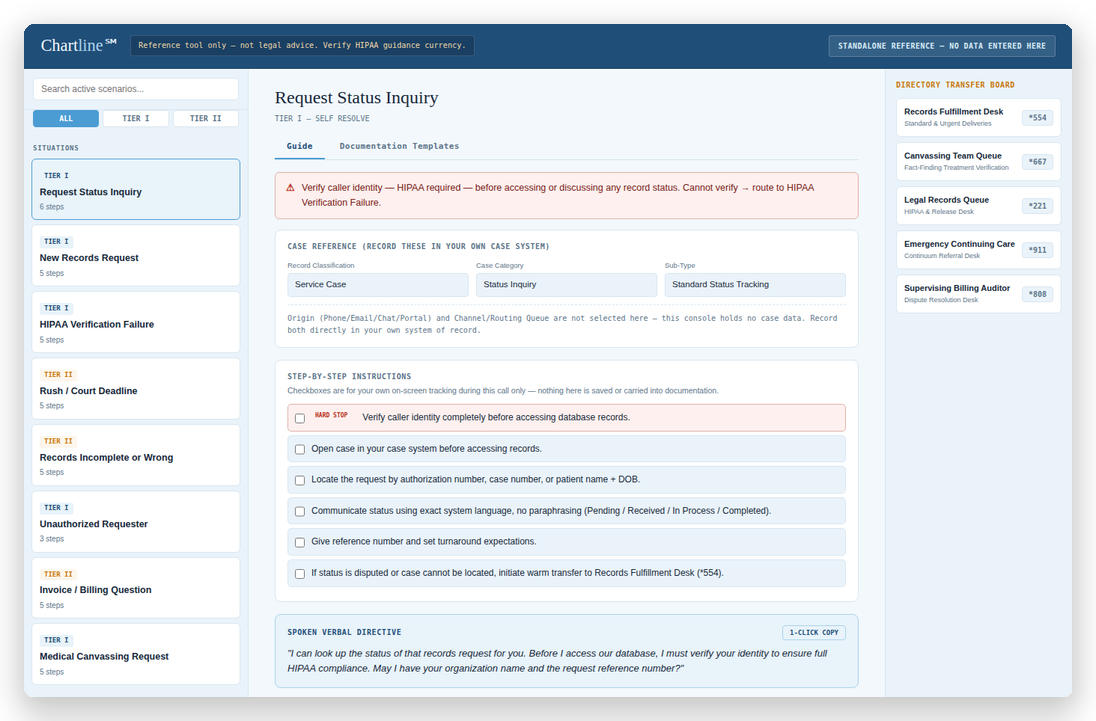
The real Chartline console, mid-call. Available live during your discovery call, or in the Demo Center.
Chartline is a custom-built reference guide for medical records coordinators who face live, high-stakes moments with attorneys, adjusters, and providers — HIPAA verification failures, court deadlines, missing records, unauthorized requesters — and need the right move right now.
The demo is illustrative of the method — not a past client's build. Yours would be built from your own source material, per the process below.
We assess your role, your highest-stakes situations, your source material, and your volume. You leave with a scoped estimate and an honest fit answer.
Constructed from official job aids and verified source documents. Situation-first design, not information categories.
Delivered as a custom HTML console. No app download, no login wall, no learning curve.
8 real situations, built from official source material and live role experience. Full situation-by-situation detail is available on request during your discovery call.
Nothing typed in is ever saved. Every note is a generic, identical-every-time template the specialist fills in on their own system of record.
Delivered as a single HTML file. No app download, no login wall, no account setup, no subscription activation.
Installs to any device and keeps working with no connection — the guide is there in the moment, signal or not.
The $500 discovery call is real working time — and if you proceed, it's credited in full toward your build.
Every step traces to your own job aids, policy manuals, and regulatory source material — never invented, never generic.
Half before work begins, half on delivery. No surprise invoicing, no ambiguity about when money moves.
The real Chartline console, mid-call. Available live during your discovery call, or in the Demo Center.
“This is the moment. You're in the moment. You can't miss the moment because you can never relive that moment. And that moment is like a crossroad. If you in it, you cross the road. If not, you may get stuck at the crossroad.”
Chartline follows the same proven build process as every Rudolph CX guide. It starts with a discovery call.
Keeps your guide current as regulations, policies, or platform workflows change. Covers one annual review cycle with revisions. Scoped changes outside the annual cycle are billed as change orders.