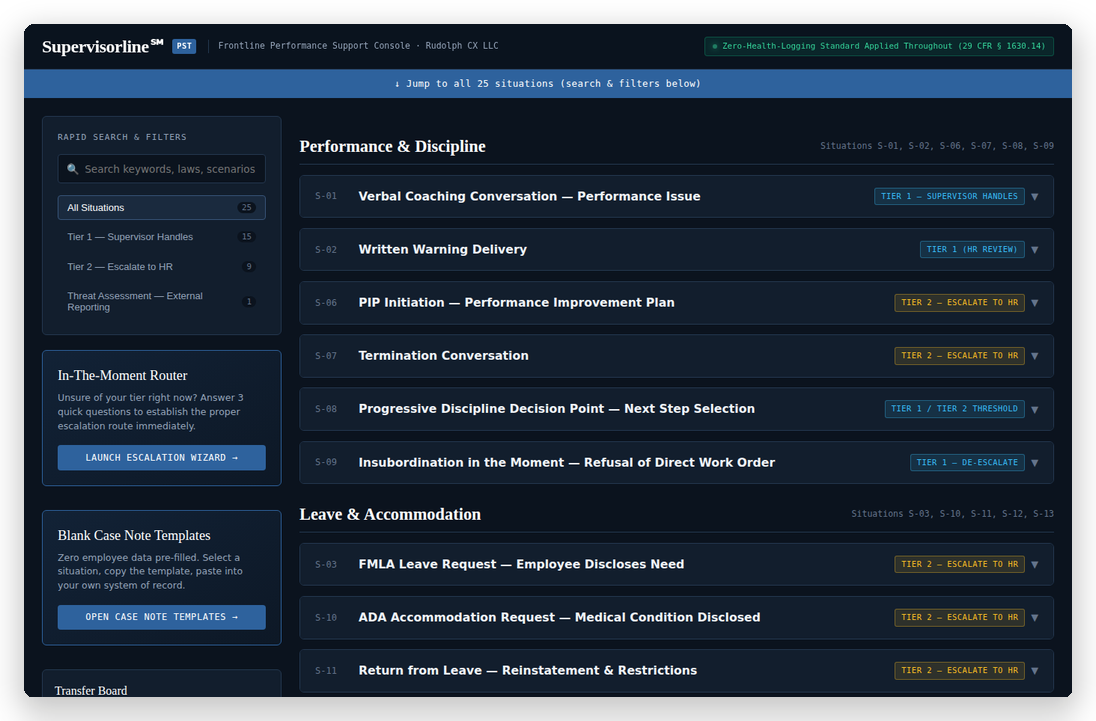
Supervisorline℠ · Performance Support · Frontline Supervision

The moment arrives.
Built for the supervisor
in the room.

Supervisors face live, high-stakes moments with no time to search a policy manual. Supervisorline℠ surfaces the complete response — routing tier, steps, what to say, when to stop — in the moment it is needed.

View situations →
47.8%
of all EEOC charges are retaliation claims — often triggered by a supervisor's response to a complaint.
EEOC / OnPay, 2026
41%
of frontline managers changed jobs in the past year — often because they felt unprepared for what the role required.
Fountain Frontline Report, 2025
Personal
liability. Managers and supervisors can be held personally liable for FLSA violations — including when they did not know the violations occurred.
Burr & Forman, 2025
Routing Architecture · Nova v1 · Session 136

Every situation has a routing tier.
Know yours before you act.

Tier 1 — Supervisor Handles

Supervisor Owns and Resolves

No protected class allegation. No formal complaint. No leave or accommodation disclosure. Within the supervisor's documented authority. HR notification is discretionary.

Tier 2 — Escalate to HR

Stop. Contact HR Before Next Action.

Employee discloses a medical condition, pregnancy, disability, or accommodation need. Any protected class allegation raised, even informally. Termination or PIP with a leave or accommodation in the background. Supervisor is uncertain whether an action would constitute retaliation.

Tier 3 — External Reporting

Legal / Compliance Now.

EEOC charge received. DOL WHD complaint filed. NLRB charge. OSHA complaint or recordable injury. Employee has retained legal counsel. No substantive decision is made without legal review.

⛔ Hard rule: The supervisor cannot make a termination, demotion, or discipline decision that involves any Tier 2 condition without HR sign-off. Any Tier 3 condition goes to Legal/Compliance immediately — not HR, not the supervisor.
Situations

25 Situations — All 5 Categories

Tier 1 — Supervisor Handles · Escalate to Tier 2 if protected class emerges
  1. 1.Before the conversation: confirm the specific performance issue, dates, and observable behaviors. Do not enter a coaching conversation based on impressions — document the specific facts you will address.
  2. 2.Open with the purpose: "I want to talk with you about [specific behavior/performance issue]. This is a coaching conversation — I want to understand your perspective and make sure we're aligned on expectations." Do not open with accusation.
  3. 3.State the specific issue, with dates and observable examples. "On [date], I observed [specific behavior]. The expectation is [standard]. The gap I'm seeing is [specific gap]."
  4. 4.Ask — do not assume. "Is there something going on that I should know about?" Listen fully before responding. If the employee discloses a medical condition, leave need, or protected class issue: stop the coaching conversation immediately and route to HR (Tier 2).
  5. 5.If no Tier 2 trigger: confirm the expectation going forward, the support you will provide, and the timeline for follow-up. Document in your own supervisor notes: date, issue discussed, employee's response, agreed next steps. Do not over-document or create a paper trail that implies termination is imminent unless that is the actual next step.
⚠ NLRA Section 7 — Right to Representation
If the employee asks to have a coworker present for a conversation they reasonably believe could result in discipline, they may have Weingarten rights if they are in a union. Non-union employees have no statutory right to representation during an investigative interview, but your organization's policy may grant it. Know your policy before the conversation.
⚠ Immediate Tier 2 Triggers
If the employee discloses a medical condition, mentions FMLA, references a pregnancy or accommodation need, or raises a discrimination or harassment allegation during the coaching conversation — stop immediately. Document that you stopped. Contact HR before any next step.
Title VII · ADA · FMLA · NLRA Section 7 · Rudolph CX Methodology
Tier 1 — Supervisor initiates · HR should review warning before delivery
47.8% of EEOC charges are retaliation claims. Discipline delivered shortly after a complaint creates timeline exposure. Know your timeline before you deliver. EEOC / OnPay, 2026
  1. 1.Before delivery: confirm HR has reviewed the written warning. Confirm the employee has no open EEOC complaint, active leave request, or recent accommodation request that could create a retaliation timeline. If any of these are present: route to HR (Tier 2) before delivering the warning.
  2. 2.Deliver in private. Have a second supervisor or HR present as a witness. Do not deliver a written warning in a public space or with non-supervisory employees present.
  3. 3.Read the warning aloud or give the employee time to read it. State the specific policy violation, the prior coaching conversation (if applicable), the dates, and the expectation going forward. Do not editorialize or extend the conversation beyond the written document.
  4. 4.Ask the employee to sign as acknowledgment — not agreement. If they refuse: note "Employee declined to sign" on the document, have the witness sign, and retain. A refusal to sign does not invalidate the warning.
  5. 5.Document: date, time, who was present, employee's response, whether they signed. Forward to HR for the personnel file. Note any commitments made by either party during the conversation.
⚠ Retaliation Timeline Risk
If the employee has filed a complaint, raised a protected class issue, or taken protected leave in the past 90 days, and a written warning is delivered shortly after, a retaliation claim becomes viable regardless of the warning's substantive merit. Have HR review the timing before delivery.
Title VII · ADA · FMLA anti-retaliation · ADEA · Rudolph CX Methodology
Tier 2 — Route to HR before any action · 5-business-day notice deadline
  1. 1.The employee does not need to say the words "FMLA" to trigger your obligation. If they mention a serious health condition, a family member's serious health condition, a surgery, childbirth, or a need for more than a few days off for a medical reason — FMLA may apply. Contact HR within 5 business days of becoming aware.
  2. 2.Do not deny, delay, or discourage. Do not say "let's see how you feel" or "can you wait until after the project?" Do not ask for more details than necessary to identify whether the request may be FMLA-qualifying. The employee is not required to diagnose their own condition.
  3. 3.Contact HR immediately. HR will: provide the FMLA notice within 5 business days, send the certification form, and manage the interactive process. Your role ends at the contact point — HR owns the FMLA process.
  4. 4.Document: the date the employee raised the leave need, the words they used, and that you immediately contacted HR. Do not document the employee's medical details — that is HR's domain, not yours.
  5. 5.During approved FMLA leave: do not contact the employee about work unless absolutely necessary and HR has cleared the contact. The supervisor cannot contact the employee's health care provider to authenticate or clarify a certification.
⚠ Direct Contact Prohibited
Under FMLA regulations, the direct supervisor cannot contact the employee's health care provider to authenticate or clarify a medical certification. Only HR or a health care professional designated by the employer may make that contact. Supervisors who attempt it create independent FMLA violations.
⚠ PWFA Overlay
If the leave need is pregnancy-related, PWFA also applies. The employee may be entitled to a reasonable accommodation short of leave — modified duties, schedule changes, more frequent breaks. HR must conduct the interactive process. Do not assume leave is the only option.
FMLA 29 CFR § 825 · PWFA (effective June 2023) · ADA · DOL FMLA regulations · Supervisor contact prohibition
Tier 2 — Route to HR immediately · Do not investigate yourself
47.8% of EEOC charges involve retaliation. The most common trigger: the supervisor's response to the initial complaint. EEOC / OnPay, 2026
  1. 1.Listen without judgment. Do not minimize ("are you sure that's how it happened?"), promise a specific outcome ("I'll make sure that person is fired"), or express disbelief. Your posture in this moment determines whether the employee will cooperate with HR's investigation.
  2. 2.Do not investigate yourself. Do not call in the accused employee. Do not ask other coworkers what they saw. Any investigation you conduct independently can taint the formal investigation HR must conduct and creates independent liability for you and the organization.
  3. 3.Contact HR immediately — same day, same shift if possible. Inform HR: that a complaint was made, the general nature of the allegation, and the identity of the complainant (unless HR instructs otherwise). HR owns the process from this point forward.
  4. 4.Tell the employee: "I am required to report this to HR. They will follow up with you directly. You will not be retaliated against for making this report — retaliation is prohibited." Do not promise confidentiality beyond what HR will actually maintain.
  5. 5.Document: date and time the employee came to you, their exact words (to the extent you can accurately recall), your immediate response, and that you contacted HR. Do not share this documentation with anyone other than HR.
⚠ If the Complaint Is About You
If the employee is making a complaint about your conduct: do not attempt to manage this yourself. Contact HR immediately and disclose that you are the subject of the complaint. Do not retaliate. Do not have further one-on-one contact with the complainant unless HR specifically authorizes it.
⚠ 8 States Have Mandatory Supervisor Training
CA, CT, DE, IL, ME, NY, WA, PR require mandatory harassment training for supervisors. CA: 2 hours, every 2 years. NY: annual. CT: within 6 months of assuming a supervisory role. Know your jurisdiction's requirement.
Title VII · ADEA · ADA · PWFA · Anti-retaliation provisions all statutes · EEOC Harassment Guidance
Tier 1 if isolated and corrected · Tier 2 if systemic · Tier 3 if DOL complaint filed
$259M recovered in back wages for 177,000 workers in FY2025. Off-the-clock work is one of the most common FLSA violations — and supervisors are personally liable. U.S. Department of Labor, January 2026
  1. 1.If you become aware that an employee is performing work before clocking in, after clocking out, during an unpaid meal break, or on their personal device after hours: you are legally required to address it. "Suffer or permit" to work means the employer owes the wages regardless of whether the supervisor explicitly authorized the work.
  2. 2.Stop the off-the-clock work immediately. Tell the employee directly: "I need you to stop working until you are clocked in. If you need to stay past your scheduled end time, clock back in. Do not perform work off the clock." Be clear and direct.
  3. 3.Correct the timekeeping for the current pay period. Work with HR/payroll to ensure the employee is compensated for any time already worked off the clock. Failure to compensate creates back pay liability plus potential liquidated damages (doubling the amount owed).
  4. 4.Determine whether this is isolated (one employee, one incident) or systemic (a practice across the team or department). If systemic: route to HR (Tier 2) and do not attempt to resolve independently. A pattern of off-the-clock work is a wage theft investigation waiting to happen.
  5. 5.Document: date and nature of the off-the-clock work discovered, correction made, timekeeping adjustment, and the conversation with the employee. If a DOL complaint has already been filed: route to Legal (Tier 3) immediately.
⚠ Personal Liability — You Are an Employer Under FLSA
Supervisors and managers who control the terms of employment — including who is assigned work and when they work — can be held personally liable for FLSA violations. Personal liability applies even when the supervisor did not know the violation was occurring. "I didn't know they were working" is not a complete defense if the supervisor had reason to know.
⚠ Tip Theft — Separate Violation
Supervisors are prohibited from keeping any portion of tips earned by employees. If tips are being pooled and any portion is directed to supervisors or managers: this is a separate FLSA violation. Contact HR (Tier 2) immediately and do not continue the practice.
FLSA 29 U.S.C. § 206-207 · "Suffer or permit" standard · Personal supervisor liability · Back wages up to 3 years (willful) + liquidated damages · DOL WHD
Tier 2 — HR reviews and approves PIP before supervisor delivers
  1. 1.Before initiating a PIP: confirm with HR that the performance issue is documented, that prior coaching conversations are on record, and that no Tier 2 conditions exist in the background (active leave request, accommodation, recent protected class complaint). A PIP delivered to an employee who recently returned from FMLA or requested an ADA accommodation creates strong retaliation exposure.
  2. 2.HR must review the PIP document before delivery. The PIP must state: specific performance gaps with measurable standards, the timeline for improvement, the support the organization will provide, and the consequence if standards are not met. Vague PIPs are challenged and lost.
  3. 3.Deliver the PIP in a private meeting with an HR representative present. Explain each section. Give the employee time to read. Ask if they have questions — do not shut down the conversation.
  4. 4.If the employee discloses a medical condition, leave need, or protected class issue during or immediately after PIP delivery: pause the PIP process and contact HR. A disclosure during a PIP conversation can restart the interactive process obligation and may require the PIP to be held.
  5. 5.Document every check-in during the PIP period. Positive progress as well as continued gaps. If the employee meets the PIP standards: close it formally. Continued documentation of only failures creates one-sided records that look punitive in litigation.
⚠ Pretextual PIP Risk
A PIP initiated shortly after a complaint, accommodation request, or protected class disclosure is a retaliation claim waiting to happen regardless of the underlying performance issue's legitimacy. HR must evaluate the timing before any PIP is initiated.
Title VII · ADA · FMLA anti-retaliation · ADEA · Rudolph CX Methodology
Tier 2 — HR approves before any termination conversation occurs
  1. 1.No termination conversation happens without HR approval. Before the conversation: HR must confirm documentation is complete, there are no Tier 2 conditions in the background, the termination is consistent with how similar situations were handled for other employees, and legal has reviewed if there is any EEOC/DOL activity connected to this employee.
  2. 2.The conversation should be brief. State the decision clearly: "Today is your last day. We are ending your employment." Do not explain at length, debate the decision, or invite negotiation. The decision is made — the conversation is notification, not discussion.
  3. 3.Have HR or a second supervisor present as a witness. Be compassionate but clear. Do not apologize in a way that implies the decision is wrong. Do not make statements about what the employee "should have done" — these become evidence.
  4. 4.Provide: information about final pay (per state law — many states require immediate or next-business-day payment), COBRA/benefits continuation notice, separation agreement if applicable (HR handles this), and return of company property.
  5. 5.If the employee becomes emotionally distressed or makes a protected class allegation during the termination conversation: document the exact words used. Do not change the termination decision based on an in-the-moment statement — but flag it to HR and Legal immediately after the meeting.
⚠ If the Employee Is on Leave or Has an Open Accommodation Request
Terminating an employee while they are on FMLA leave, or while an ADA accommodation request is pending, is presumptively retaliatory. HR and Legal must review before any termination conversation occurs in these circumstances.
Title VII · ADA · FMLA · ADEA · WARN Act (for larger layoffs) · State final pay laws vary
Tier 1 for early steps · Tier 2 when final warning or termination is the next step
  1. 1.Before deciding the next disciplinary step: confirm what the prior steps were and what was documented. Progressive discipline requires consistency — the same step for the same issue at the same stage. Skipping steps or jumping to termination without documentation invites challenge.
  2. 2.Confirm what your organization's progressive discipline policy states. Policy defines the steps — verbal warning, written warning, final warning, termination. Deviating from policy without documented justification creates inconsistency that is hard to defend.
  3. 3.Check: has this same issue been handled consistently for other employees? If one employee was verbally warned for the same issue and this employee is being written up, document why the difference is justified. Inconsistent treatment by protected class is a disparate treatment claim.
  4. 4.If the next step is a final warning or termination: route to Tier 2. HR must review before the next conversation with the employee. No final warning or termination without HR sign-off.
  5. 5.Document the decision and rationale before the conversation happens — not after. A well-dated pre-conversation memo establishes the decision was not reactive to anything the employee said in the meeting.
⚠ Consistency Is the Defense
The single most effective defense against a discrimination claim in a discipline case is documented, consistent application of the same standard to all employees. Build that record from the first coaching conversation.
Title VII · ADEA · ADA · Organizational policy governs steps · Rudolph CX Methodology
Tier 1 — supervisor manages in the moment · Tier 2 if safety concern or formal complaint follows
  1. 1.Do not escalate the confrontation. Raising your voice, making threats, or issuing ultimatums in the moment makes the situation worse and creates a hostile environment allegation risk. Lower your register, create physical space, and lower the stakes of the immediate exchange.
  2. 2.State the directive clearly and once: "I need you to [specific action] by [specific time]. We can discuss your concerns after." Do not repeat the directive five times — repetition signals that the employee can negotiate the outcome.
  3. 3.If the employee continues to refuse: end the immediate conversation. "We'll pause here and continue this conversation after your shift / in my office at [time]." Do not conduct a discipline conversation on the floor in front of other employees.
  4. 4.If the employee's refusal involves a safety concern (they are refusing to do something because they believe it is unsafe): this is protected activity under OSHA. Do not discipline for a safety-related refusal until you have confirmed the safety concern is unfounded. Contact HR if the employee cites safety as the reason for refusal.
  5. 5.Document immediately after the incident: exact words the employee used, your response, witnesses present, time, location. Document while it is fresh. This contemporaneous record is critical if the situation escalates to formal discipline.
⚠ NLRA Section 7 — Protected Concerted Activity
If the employee is refusing a directive in coordination with other employees (a group refusal, a work slowdown, or a complaint about working conditions on behalf of the group), this may be protected concerted activity under the NLRA. Do not discipline for group refusals related to wages, hours, or working conditions without HR review.
OSHA General Duty Clause · NLRA Section 7 · Title VII (if refusal tied to protected class issue) · Rudolph CX Methodology
Tier 2 — HR owns the interactive process · Supervisor does not conduct alone
  1. 1.The employee does not need to use the word "disability" or "accommodation" to trigger your ADA obligation. If they disclose a medical condition that affects their ability to perform their job, or ask for a change in duties, schedule, or equipment for a medical reason — route to HR immediately.
  2. 2.Do not deny the request yourself. Do not say "we can't do that" or "that's not how we operate" before HR conducts the interactive process. The ADA requires a good-faith interactive process — an immediate denial by the supervisor bypasses it entirely and creates direct liability.
  3. 3.Contact HR the same day. HR will: initiate the interactive process, request medical documentation (through proper channels — not you), evaluate whether a reasonable accommodation exists, and document the process.
  4. 4.During the interactive process: continue to treat the employee as you would any other employee. Do not alter their schedule, duties, or workload unilaterally while accommodation is pending — changes without HR guidance can themselves become ADA claims.
  5. 5.Document that you received the disclosure and immediately contacted HR. Do not document the medical details the employee shared — that is HR's domain and must be kept in a separate file from the personnel file under ADA confidentiality requirements.
⚠ ADA Confidentiality — Medical Information Is Not Personnel Information
Medical information shared during an ADA accommodation request must be kept in a separate, confidential file — not the employee's general personnel file. Supervisors who share an employee's medical information with coworkers, other supervisors, or anyone without a need to know create independent ADA violations.
ADA 42 U.S.C. § 12101 · ADAAA · Interactive process requirement · Medical record confidentiality 29 CFR § 1630.14
Tier 2 — HR manages reinstatement · Supervisor does not determine position on return alone
  1. 1.When an employee returns from FMLA leave: they are entitled to restoration to the same position or an equivalent position with the same pay, benefits, and terms. You cannot return them to a lesser position, reduce their duties, or change their schedule as a result of the leave.
  2. 2.Before the return date: contact HR to confirm the reinstatement plan. If the employee's position was backfilled, HR must determine whether the backfill is displaced or whether an equivalent position exists. The supervisor does not make this determination independently.
  3. 3.If the employee returns with restrictions (can't lift, needs modified schedule): an ADA interactive process may be required simultaneously with the FMLA reinstatement. Contact HR immediately — the overlap of FMLA reinstatement and ADA accommodation is a high-exposure situation.
  4. 4.Do not initiate performance conversations, PIPs, or discipline within a short window of an employee's return from protected leave unless those actions were already in progress before the leave began and are documented as such. The timing creates retaliation exposure.
  5. 5.Document the return: date, position restored, any agreed modifications (through HR), and that the return was processed per the leave policy. File with HR — not in your own notes only.
⚠ Post-FMLA ADA Additional Leave
When FMLA exhausts and the employee still cannot return, ADA may require additional unpaid leave as a reasonable accommodation. HR and Legal must evaluate. The supervisor cannot simply terminate when FMLA runs out without this analysis.
FMLA 29 CFR § 825.214 (restoration) · ADA post-FMLA leave analysis · PWFA if pregnancy-related · Rudolph CX Methodology
Tier 2 — HR owns PWFA interactive process · Do not deny or delay
  1. 1.The PWFA (effective June 2023) requires covered employers to provide reasonable accommodations to employees with limitations related to pregnancy, childbirth, or related medical conditions — even if those limitations do not rise to the level of a disability under the ADA. The PWFA is broader than the ADA for this population.
  2. 2.Common PWFA accommodations: more frequent or longer bathroom breaks, modified schedule or shift, temporary reassignment from strenuous duties, ability to sit while working, closer parking. These are presumptively reasonable. Do not deny them without HR review.
  3. 3.Contact HR the same day the employee makes any pregnancy-related request or disclosure that touches their ability to perform their job. HR initiates the interactive process and coordinates with the employee on documentation needs.
  4. 4.Do not ask the employee for more medical detail than necessary. Do not ask questions about the pregnancy beyond what is needed to understand the limitation and evaluate the accommodation request.
  5. 5.The PWFA prohibits retaliation. Any adverse action taken after a PWFA accommodation request — including schedule changes that disadvantage the employee, performance documentation that begins post-disclosure, or expressions of frustration about coverage — creates retaliation exposure.
⚠ PWFA: 7 EEOC Lawsuits Filed in 2025 Including $100,000 Consent Decree
EEOC enforcement of PWFA is active. Supervisors who deny pregnancy-related accommodation requests without HR review are creating direct organizational and personal liability.
PWFA (effective June 27, 2023) · ADA · Title VII Pregnancy Discrimination Act · EEOC PWFA enforcement 2025
Tier 1 for attendance conversation · Tier 2 if FMLA/ADA trigger is present
  1. 1.Before any attendance conversation: review the pattern. Are the absences on specific days (every Monday)? Are they related to a medical condition the employee has disclosed? Are they connected to a family member's health? Each pattern carries different legal exposure.
  2. 2.If the absences may be FMLA-qualifying (related to a serious health condition of the employee or family member, or occurring intermittently for a medical reason): do not address them as a pure attendance issue. Contact HR before any attendance conversation. The employee may be entitled to FMLA-protected intermittent leave.
  3. 3.If no FMLA trigger is identified: conduct a private conversation about the attendance pattern. State the specific absences, the impact on the team, and the attendance standard. Ask openly: "Is there something going on I should know about?" Listen fully. If the employee discloses a medical condition: route to HR (Tier 2) immediately.
  4. 4.Do not issue discipline for absences that turn out to be FMLA-qualifying. Discipline for FMLA-protected absences is an FMLA interference claim — one of the most straightforward claims to prove.
  5. 5.Document the attendance record accurately. Date, reason given (if any), and impact. Do not editorialize ("clearly does not want to be here") — stick to observable facts.
⚠ Intermittent FMLA — Do Not Count It Against Attendance
If an employee is on approved intermittent FMLA, their FMLA-protected absences cannot count toward attendance discipline. Tracking them or including them in an attendance warning creates FMLA interference liability. HR must flag which absences are FMLA-protected.
FMLA 29 CFR § 825 (intermittent leave) · ADA reasonable accommodation for chronic conditions · Rudolph CX Methodology
Tier 1 for interpersonal conflict · Tier 2 immediately if harassment or discrimination raised
  1. 1.Meet with each employee separately first. Do not bring them together until you understand each perspective. In a joint meeting before individual conversations, you risk one party dominating or the other party feeling ambushed.
  2. 2.Listen for protected class content in each employee's account. If either employee describes the other's behavior in terms that reference race, gender, religion, national origin, disability, age, or any other protected class: stop the informal mediation and route to HR (Tier 2) immediately. You are no longer mediating a personality conflict — you are handling a potential discrimination or harassment situation.
  3. 3.If no protected class content: focus each conversation on observable behavior and its impact on work. "When X happens, the effect on the team is Y." Do not ask employees to diagnose each other's motivations.
  4. 4.If appropriate, bring the employees together for a structured conversation. State the ground rules: focus on behaviors, not character; each person speaks, the other listens; the goal is to define what both parties will do differently going forward.
  5. 5.Document the resolution: what each party agreed to, date, and that you will follow up in 30 days. If the conflict continues or escalates after the conversation: escalate to HR (Tier 2).
⚠ Do Not Promise Confidentiality You Cannot Keep
If either employee discloses something during an individual conversation that rises to a harassment or discrimination allegation, you are required to report it to HR. Do not promise confidentiality before you know what the employee will say.
Title VII · ADA · NLRA Section 7 · Rudolph CX Methodology
Tier 2 — HR owns any investigation · Supervisor does not investigate
  1. 1.Receive the report. Do not minimize, dismiss, or immediately defend the accused employee. "I find that hard to believe" and "that doesn't sound like them" are statements that can be used to show the organization failed to take the complaint seriously.
  2. 2.Contact HR immediately. The supervisor's role ends at intake. HR will determine whether to investigate, how to investigate, and what interim measures are needed while the investigation proceeds (e.g., separating the parties).
  3. 3.Do not tell the accused employee about the complaint before HR decides how to proceed. Premature disclosure can compromise the investigation, create a retaliation risk, or cause destruction of evidence.
  4. 4.If the accused employee is the supervisor's peer or a senior leader: route directly to HR. Do not attempt to manage a situation involving someone at or above your level.
  5. 5.Document: what was reported, by whom, in what words, on what date. Forward to HR. Do not share with anyone else on the team.
⚠ No Informal Resolution for Misconduct Allegations
Do not attempt to resolve a misconduct allegation informally — talking to both parties, getting them to shake hands, or telling the complainant "I'll have a word with them." This approach fails the complainant, fails the accused's right to a fair process, and creates organizational liability.
Title VII · EEOC Harassment Guidance · Organizational investigation policy · Rudolph CX Methodology
Tier 3 — Do not discipline · NLRB violation risk · Contact HR and Legal before any action
  1. 1.Stop. Under Section 7 of the NLRA, employees have the right to discuss their wages, hours, and working conditions with each other. This right applies to virtually all private-sector non-supervisory employees regardless of whether they are in a union.
  2. 2.Do not issue a verbal warning, written warning, or any form of discipline for wage discussions between employees. Do not send an email telling employees not to share pay information. Discipline for protected wage discussion is an NLRA violation — an unfair labor practice charge filed with the NLRB.
  3. 3.Contact HR immediately. If your organization has a policy that restricts wage discussions among employees, that policy is likely unenforceable and itself an NLRA violation. HR and Legal need to evaluate.
  4. 4.Do not retaliate in any indirect way — reducing hours, reassigning shifts, increasing scrutiny. Any adverse action connected to the wage discussion creates NLRB exposure and potential back pay liability.
  5. 5.The only wage-related conversation supervisors may restrict: employees disclosing wage information they accessed through their supervisory role (e.g., payroll access) as part of their job duties — not wages they disclosed about themselves. Know the distinction.
⚠ This Is Not Discretionary
NLRA Section 7 is a federal right. Disciplining an employee for wage discussion is an unfair labor practice. It does not matter what the employee handbook says, what the supervisor was told by a prior manager, or whether the organization is union or non-union. Contact Legal before any action.
NLRA Section 7 · NLRB unfair labor practice charges · Section 8(a)(1) employer interference prohibition
Tier 1 initially · Tier 2 if FMLA or medical emergency surfaces
  1. 1.Attempt contact. Call the employee's direct number, then any emergency contact on file. Document each attempt with the time and outcome. Multiple contact attempts establish that the absence was unexcused — not that the organization failed to check.
  2. 2.After the employee returns or makes contact: have a private conversation before they resume work. "I need to understand what happened. You were scheduled [day/shift] and we didn't hear from you." Listen fully before any disciplinary response.
  3. 3.If the employee explains a medical emergency — their own or a family member's — assess whether the absence may be FMLA-qualifying. If yes: contact HR (Tier 2) before issuing any discipline. A no-call/no-show that turns out to be FMLA-protected cannot be disciplined as an attendance violation.
  4. 4.If the employee provides no reason or an unprotected reason: follow the progressive discipline policy for unexcused absences. Document the conversation and the disciplinary step taken.
  5. 5.If the employee has not contacted the organization after a defined period (typically 3 consecutive days per policy): consult HR before treating the absence as a voluntary resignation. "Job abandonment" terminations without confirmed contact attempts are challenged and sometimes reversed.
⚠ Three-Day No Call May Not Be Job Abandonment
Some states have specific job abandonment statutes or regulations. Some collective bargaining agreements define abandonment differently than policy. And a hospitalization or other emergency can explain even a multi-day no-call. HR must confirm before any termination for job abandonment.
FMLA 29 CFR § 825.303 (employee notice requirements) · Organizational attendance policy · State law varies · Rudolph CX Methodology
Tier 2 — HR and EAP · Do not attempt to assess or treat
  1. 1.If you observe signs of significant distress — crying, withdrawal, erratic behavior, statements about hopelessness or not wanting to be here — respond with human compassion first. "I can see you're having a hard time. I want to make sure you're okay." Create a private space for the conversation.
  2. 2.Do not attempt to diagnose, assess risk level, or counsel the employee on mental health. You are not equipped to make clinical assessments and should not try. Your role is to connect the employee to support — not to provide it yourself.
  3. 3.Contact HR immediately. If the organization has an Employee Assistance Program (EAP): provide the employee with EAP contact information. The EAP is confidential — the supervisor and employer do not learn what the employee discusses with the EAP.
  4. 4.If the employee makes any statement that suggests they may harm themselves or others: this is a crisis. Do not leave them alone. Contact HR and, if the threat appears imminent, contact emergency services. This is the one situation where the supervisor cannot simply pass the situation to HR and step back.
  5. 5.After the immediate situation: document in general terms (employee appeared distressed, HR was notified, EAP information was provided). Do not document specific statements about the employee's mental health in your supervisor notes — route that documentation through HR.
⚠ ADA May Apply
Mental health conditions — including depression, anxiety, PTSD, and bipolar disorder — can qualify as disabilities under the ADA. If the employee's distress is related to a mental health condition, an accommodation request may follow. HR must manage that process.
ADA (mental health as disability) · MHPAEA (parity rule effective Nov 22, 2024) · EAP confidentiality · OSHA General Duty Clause (workplace violence)
Tier 1 — supervisor responds with compassion · Tier 2 if leave need emerges
  1. 1.Listen. An employee disclosing a personal crisis — domestic violence, serious illness in the family, financial emergency, housing crisis — is extending trust. Receive it without judgment, without problem-solving immediately, and without minimizing.
  2. 2.Separate the person from the performance. You may need to address the employee's performance or attendance — but not in the same conversation as the crisis disclosure. "Thank you for telling me. Right now I just want to make sure you know we support you. We can talk about work logistics separately."
  3. 3.Provide EAP information. "Our EAP is confidential — no one here learns what you discuss with them. They can help with a range of personal situations." Do not require them to use it — offer it.
  4. 4.If the crisis may require leave: ask HR about available options — FMLA (if applicable), state leave laws, organizational leave policies. Do not promise specific leave arrangements before checking with HR.
  5. 5.Do not share what the employee disclosed with other team members, even informally. "You should know [name] is going through something" violates the employee's privacy and trust, and in some circumstances (domestic violence) can create safety risks.
⚠ Domestic Violence and Workplace Safety
If an employee discloses a domestic violence situation and you have reason to believe it could affect workplace safety (an abuser may come to the workplace), contact HR immediately. Several states have specific legal protections for domestic violence survivors that affect leave rights and employer obligations.
ADA (crisis may disclose underlying disability) · State domestic violence leave laws vary · FMLA if family health need · EAP confidentiality
Tier 1 — supervisor manages team response · HR coordinates policy and leave
  1. 1.Acknowledge the loss directly with the team. Do not avoid it or pretend it is not affecting people. "I know many of you are aware of [what happened]. I want to acknowledge how hard this is. We are here to support each other." Silence from the supervisor amplifies distress.
  2. 2.Give people permission to not be okay. Performance expectations may need to flex temporarily. Check in with individual employees, especially those who were close to the deceased. Be present — not just task-focused.
  3. 3.Connect to EAP. Grief counseling is often an EAP service. Make the information available without requiring use. "I want everyone to know our EAP is available for grief support — it's confidential and completely optional."
  4. 4.Coordinate with HR on bereavement leave if applicable. Know your organization's policy — how many days, for which relationships, with what documentation requirements. Do not apply the policy inconsistently across the team.
  5. 5.In the weeks that follow: continue to check in. Grief does not resolve in the bereavement leave window. Employees who return quickly may still be significantly impacted. Notice behavioral changes and offer EAP proactively if distress continues.
The Supervisor's Role in Grief
Supervisors are not grief counselors — but they are the person the team sees first. How you respond in the first 24 hours shapes how the team experiences the organization's care for them. Being present, naming the loss, and creating permission to feel it is the supervisor's job.
Organizational bereavement policy · ADA if grief triggers underlying mental health condition · EAP referral protocol
Tier 2 — Safety officer and HR immediately · Supervisor secures scene and documents
  1. 1.Ensure the injured employee receives immediate medical attention. Do not delay care to complete paperwork. If the injury requires emergency medical response: call 911 first.
  2. 2.Secure the scene. Preserve the conditions as they existed at the time of the injury. Do not move equipment, clean up spills, or alter the environment until safety has evaluated the scene — preserving the scene is required for OSHA investigation.
  3. 3.Contact the safety officer and HR immediately. They will determine: whether the injury is OSHA-recordable, whether OSHA reporting is required (fatalities and hospitalizations have 8-hour and 24-hour reporting deadlines), and how to conduct the incident investigation.
  4. 4.Document witness information while the scene is fresh — names of anyone who observed the incident or was nearby. Do not coach witnesses on what to say. Do not suggest the employee was at fault before any investigation.
  5. 5.Do not retaliate against the injured employee for reporting the injury or for filing a workers' compensation claim. Adverse actions following a workplace injury report are OSHA-retaliation violations under Section 11(c).
⚠ OSHA Reporting Deadlines Are Hard
Fatalities: report to OSHA within 8 hours. In-patient hospitalization, amputation, or loss of an eye: report within 24 hours. These are not optional — failure to report on time is a separate OSHA violation.
OSHA General Duty Clause · OSHA recordkeeping (29 CFR § 1904) · OSHA Section 11(c) anti-retaliation · Workers' compensation state law
Tier 3 — Do not attempt to de-escalate alone · Security, HR, and Legal immediately
  1. 1.Take every threat seriously. Do not make a judgment call about whether the person "really means it." Document the exact words used, context, and witnesses. Treat as credible until security and HR assess.
  2. 2.If the threat is immediate and specific: call 911 first. Your job is to protect people in the space, not to manage the situation alone. Get others away from the individual if it can be done safely.
  3. 3.Contact security and HR simultaneously. Do not confront the employee alone. Do not attempt to "talk them down" unless you have specific training. You are not the right person to de-escalate a credible workplace violence situation.
  4. 4.Document exactly what was said, by whom, to whom, in what context, and who witnessed it. Do not paraphrase — use quotation marks for the actual words. This documentation is the foundation of both the security response and any subsequent legal action.
  5. 5.Do not share the threat details broadly with the team before security has assessed and a communication plan is in place. Uncoordinated disclosure can escalate fear or tip off the individual that the threat has been reported.
⚠ OSHA General Duty Clause — Workplace Violence Is a Safety Issue
Employers have an obligation under the OSHA General Duty Clause to maintain a workplace free from recognized hazards, including workplace violence. Failure to respond to a documented threat that later results in harm creates OSHA liability.
OSHA General Duty Clause · ADA (mental health may be relevant to response) · State criminal statutes · NLRA (if threat related to labor activity)
Tier 1 — supervisor answers per pay transparency policy · Tier 2 if pay equity allegation raised
  1. 1.Know your jurisdiction. As of 2026, 17 states plus Washington D.C. have active pay transparency laws — many require employers to provide pay ranges upon request or to include them in job postings. Check which state law applies to this employee's location.
  2. 2.If your jurisdiction requires disclosure and your organization has a policy: provide the range as stated in policy. Do not editorialize about where the employee falls within it without HR guidance — that conversation is more complex than a range disclosure.
  3. 3.If the employee asks where they fall within the range: you can share their current rate if you have it and policy permits. If they then raise a concern about why they are at a particular point in the range relative to peers: this is now a potential pay equity conversation. Route to HR (Tier 2).
  4. 4.Do not tell an employee the range is confidential if you are in a jurisdiction that requires disclosure — that statement itself may be an NLRA or state pay transparency violation.
  5. 5.Document the conversation: what the employee asked, what you provided, and any follow-up requested. If the conversation escalated to a pay equity concern: note that HR was contacted.
⚠ 17 States + D.C. Have Active Pay Transparency Laws
CA, CO, CT, DE (eff. 2027), HI, IL, ME, MD, MA, MN, NV, NJ, NY, RI, VT, WA, plus D.C. Affecting an estimated 65% of U.S. employers. Know your state's specific requirement before any pay range conversation.
State pay transparency laws (2026) · NLRA Section 7 (wage discussion rights) · EPA / Title VII if pay equity issue surfaces
Tier 1 for standard delivery · Tier 2 immediately if protected class disparity raised
  1. 1.Before the conversation: know the rationale for the raise decision. Be able to explain it in terms of performance, role scope, market data, or tenure — not in terms of the employee's financial situation, their willingness to accept less, or subjective impressions. Unexplained disparities between similarly situated employees are pay equity claims.
  2. 2.Deliver the amount and effective date clearly. Do not hedge or make the employee guess. "Your merit increase is X%, effective [date]. Your new rate is $Y." Then explain the rationale: "This reflects [performance factors]."
  3. 3.If the employee is disappointed and asks how their raise compares to others: do not reveal other employees' specific rates. You can explain the process: "Increases are determined by [factors] and applied consistently across the team." Do not speculate about what others received.
  4. 4.If the employee raises a concern that their raise is lower than a colleague's because of their race, gender, age, or other protected class: route to HR immediately (Tier 2). Do not attempt to resolve a pay equity allegation in the raise conversation.
  5. 5.Document the conversation: amount communicated, effective date, employee's response, and any follow-up questions raised. If a pay equity concern was raised: note that HR was contacted.
⚠ Comments During Raise Conversations Create Exposure
Statements interpreted as discriminatory during a raise conversation — "you're doing well for someone who just came back from leave," "you shouldn't need more given your family situation" — create independent Title VII claims. Stick to performance and process language.
EPA · Title VII · ADEA · State equal pay laws · NLRA Section 7 (wage discussion rights cannot be restricted) · PBW Law 2026
Tier 1 to explain lawful tip policy · Tier 2+3 immediately if supervisor participation alleged
  1. 1.Know the rule before the conversation: under the FLSA, tips always belong to the employees who earned them. Employers and supervisors are prohibited from keeping any portion of employees' tips for any reason. Tip credits and tip pools have specific rules — know your organization's policy and whether it complies.
  2. 2.A lawful tip pool: employers who pay the full minimum wage (not using a tip credit) may operate a tip pool that includes non-tipped workers (e.g., cooks, dishwashers). Supervisors and managers are excluded from the pool — always.
  3. 3.If the employee is asking how the tip pool works: explain the policy in plain terms. "Tips are pooled among [positions]. [X%] goes to [position]. Here's how it breaks down." If you do not know the details: get them from HR before the conversation.
  4. 4.If the employee alleges that a supervisor or manager has been receiving a share of the tip pool: this is a FLSA violation. Route to HR and Legal (Tier 2 + Tier 3) immediately. Do not attempt to investigate or resolve this yourself. The DOL WHD will.
  5. 5.Document the conversation: what the employee asked, what you explained, and whether a potential violation was raised. If a violation was raised: note HR was contacted.
⚠ Supervisors Cannot Participate in Tip Pools — Ever
FLSA prohibition is absolute: managers and supervisors cannot keep any portion of employees' tips, regardless of how the tip pool is structured or what the organization's policy says. A policy that gives supervisors a tip share is an unenforceable FLSA violation.
FLSA 29 U.S.C. § 203(m) · Tip pool rules (Consolidated Appropriations Act 2018) · DOL WHD tip enforcement · State tip laws may be stricter
This guide supports supervisors in navigating live workplace moments. It does not constitute legal advice. When in doubt about legal exposure, consult HR before acting. Supervisors have personal liability under FLSA — including for violations they did not know occurred. Regulatory citations reflect research as of Session 131 (June 2026). Verify currency before applying. Built from 3-track primary source research · Rudolph CX LLC · Nova routing rules Session 136
Pricing

One process. One contract.
Built for your organization.

Supervisorline℠ follows the same proven build process as every Rudolph CX guide. Custom-built from your organization's situations, policies, and regulatory landscape. Delivered in two weeks. No IT required.

Book a discovery call →
Start Here

Request a custom build
for your organization.

Tell us your role and industry. We'll send a sample built from a situation your supervisors face — before any commitment.

Book Discovery Call — $300 →

or email: jamal@rudolphcx.com